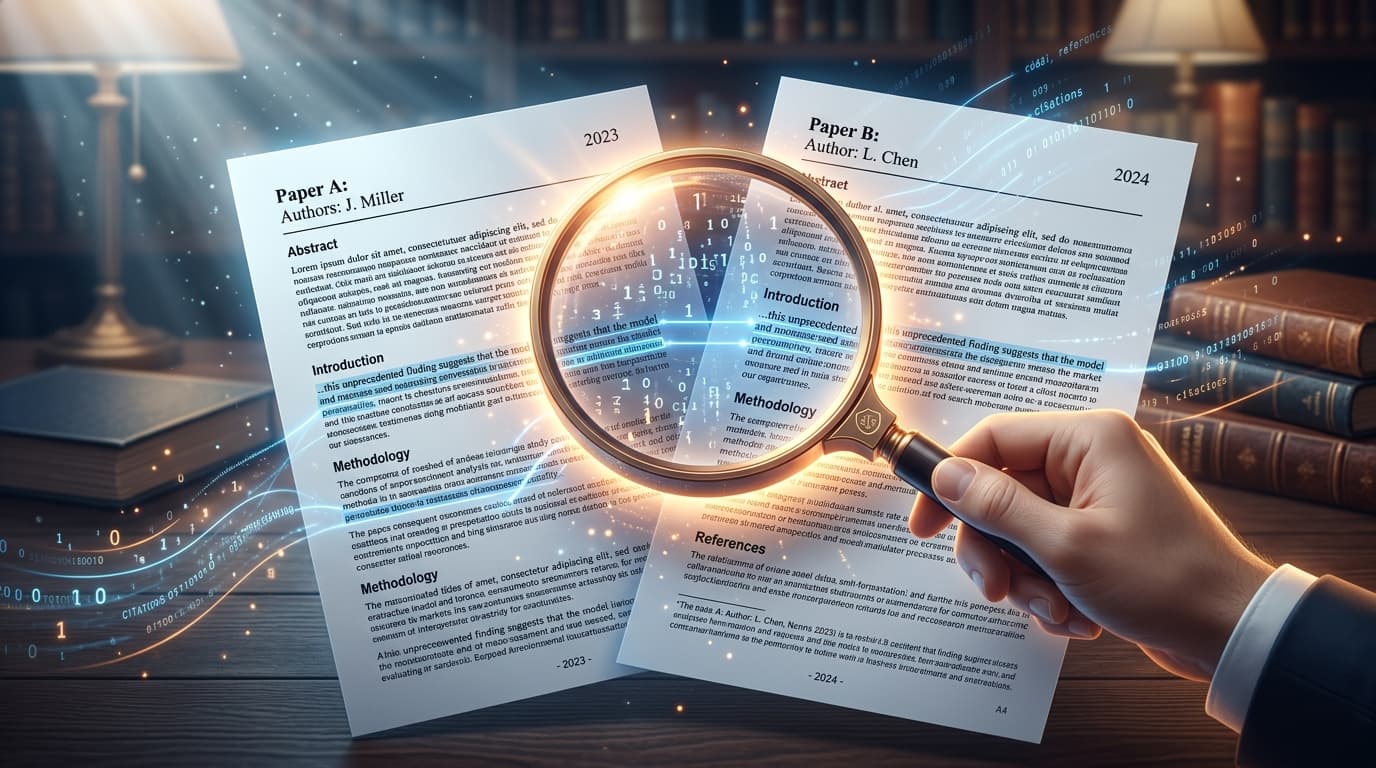
Academic integrity is the cornerstone of scholarly research. At its core, the scientific method and humanistic inquiry both depend on a fundamental trust: the trust that the findings presented are genuine, and that the ideas expressed are properly attributed to their originators. Unfortunately, one of the most persistent threats to this trust is plagiarism. But what exactly counts as plagiarism in academic research? The concept extends far beyond the simplistic "copying and pasting" most people learn about in high school. In the competitive, high-stakes environment of higher education and professional academia, understanding the nuanced forms of plagiarism—and mastering the skills to avoid them—is absolutely essential.
This comprehensive guide dives deep into the mechanisms of academic plagiarism. We will explore direct plagiarism, mosaic plagiarism, the often-misunderstood self-plagiarism, accidental plagiarism, and the modern complexities introduced by AI-assisted writing. Whether you are currently meticulously crafting a Literature Review or outlining the early stages of a Dissertation Proposal, mastering these concepts will safeguard your academic reputation and elevate the quality of your scholarship.
The Spectrum of Plagiarism: Beyond Simple Theft
Plagiarism is often defined as the appropriation of another person's ideas, processes, results, or words without giving appropriate credit. However, the American Psychological Association (APA) and the Modern Language Association (MLA) emphasize that plagiarism is a spectrum, ranging from egregious, deliberate theft to subtle, unintentional oversights in citation mechanics.
1. Direct Plagiarism: The Most Severe Offense
Direct plagiarism is the verbatim copying of another author's work without using quotation marks and without proper attribution. It is the most blatant form of academic dishonesty and carries the most severe penalties, often resulting in expulsion from degree programs or retraction of published papers.
Why does direct plagiarism happen at the highest levels of academia? The intense pressure to publish ("publish or perish"), extreme deadlines, and occasionally, a fundamental misunderstanding of academic writing conventions can lead scholars down this path. However, in the academic community, intent often matters less than the act itself. If the words match another source without quotation marks and citation, it is direct plagiarism, irrespective of whether the author meant to deceive or merely forgot to format their notes correctly.
2. Mosaic Plagiarism (Patchwriting)
Mosaic plagiarism, sometimes referred to as patchwriting, is a far more insidious and common problem. It occurs when a writer borrows phrases from a source without using quotation marks, or finds synonyms for the author's language while keeping the same general structure and meaning as the original. Instead of a wholesale copy-paste, the writer weaves someone else's ideas and phrasing into their own work, creating a "mosaic."
Consider this example:
- Original Text: "The rapid proliferation of digital communication tools has fundamentally altered the landscape of modern interpersonal relationships, leading to a paradox of increased connectivity paired with heightened social isolation."
- Mosaic Plagiarism: "The fast spread of digital communication platforms has completely changed the terrain of today's interpersonal relationships, creating a paradox where greater connectivity is matched by increased social isolation."
Even if the writer cites the original source at the end of the sentence, this is still plagiarism. Why? Because the writer has stolen the intellectual architecture of the sentence. The syntax, the rhythm, and the precise flow of logic still belong to the original author. Proper paraphrasing requires a complete restructuring of the idea into your own unique voice.
3. Self-Plagiarism: Stealing from Yourself?
Many students and researchers are baffled by the concept of self-plagiarism. After all, if you wrote it, how can you steal it? The confusion stems from the term itself. A more accurate phrase is "duplicate publication" or "text recycling."
In academia, when you submit a paper for a grade, or when you publish an article in a journal, the expectation is that the work is entirely original and novel. If you submit a paper for a graduate seminar that you previously submitted as an undergraduate, you are violating the expectation of novel work for that specific course. Furthermore, in the publishing world, when you publish an article, you typically sign the copyright over to the journal. Reusing large chunks of that text in a new book chapter without citation is legally a copyright violation, and academically, it misrepresents the amount of original research being presented.
You can absolutely build upon your previous research. However, you must cite your past work just as you would cite any other scholar's work. If you need to reuse a specific paragraph because it perfectly summarizes your methodology, put it in quotes and cite yourself.
4. Accidental Plagiarism: The Danger of Sloppy Notes
Accidental plagiarism occurs when a researcher neglects to cite their sources, misquotes their sources, or unintentionally paraphrases a source by using similar words, groups of words, and/or sentence structure without attribution. Lack of intent does not absolve the writer of responsibility.
The most common culprit here is poor research management. When reviewing dozens of articles for a Literature Review, researchers often copy and paste text into a running "notes" document. If they fail to clearly distinguish in their notes which text is a direct quote and which text is their own summary, they may later incorporate the direct quotes into their draft, believing them to be their own original thoughts.
The Art and Science of Proper Paraphrasing
Paraphrasing is not simply swapping out words with synonyms from a thesaurus. It is a cognitive process that requires you to deeply understand the source material, digest it, and then explain it back to the reader as if you were explaining it to a colleague over coffee.
To effectively paraphrase, follow the 4-R Method:
- Read: Read the passage several times until you fully grasp its meaning.
- Remove: Set the original text aside. Hide it from view. Do not look at it while you write.
- Rewrite: Write down the core idea in your own words. Focus on the meaning, not the words.
- Review: Compare your version to the original. Did you capture the essence without copying the structure or unique phrasing? If your version is too similar, repeat the process.
When to Quote vs. When to Paraphrase
In fields like literature or history, the specific words an author uses are often as important as the ideas themselves, making direct quotes more common. However, in the social sciences, STEM fields, and most empirical research, paraphrasing is vastly preferred over direct quotation.
You should only use direct quotes when:
- The author has coined a unique term or phrase that cannot be altered without losing its meaning.
- The exact wording is historically significant.
- The original phrasing is so brilliantly concise and elegant that any attempt to paraphrase it would significantly dilute its impact.
In all other cases, synthesize the information and write it in your own voice. A paper consisting of strung-together quotes, even if cited perfectly, demonstrates a lack of synthesis and original thought.
AI-Assisted Writing: The New Frontier of Academic Integrity
The advent of Large Language Models (LLMs) like ChatGPT, Claude, and Gemini has thrown the academic world into turmoil. The intersection of generative AI and plagiarism is a complex, rapidly evolving landscape.
Is using AI considered plagiarism? The academic consensus is moving toward categorizing undisclosed AI use not necessarily as traditional plagiarism (since the AI is not a "person" whose work you are stealing), but rather as academic dishonesty or fraud. You are presenting work as your own original cognitive effort when, in fact, a machine generated it.
Acceptable vs. Unacceptable AI Use
Universities and journals are currently drafting specific policies, and you must always defer to the specific rules of your institution or target publication. However, general guidelines are emerging:
Generally Acceptable Uses (Often requiring disclosure):
- Using AI for grammar checking, spell checking, and minor stylistic polishing (similar to Grammarly).
- Using AI to help brainstorm topics or generate initial outlines for a Dissertation Proposal.
- Using AI to help format citations or write code scripts for data analysis (e.g., asking an AI for the R syntax to run a specific ANOVA).
Generally Unacceptable Uses:
- Using AI to write entire paragraphs, sections, or papers and presenting them as your own.
- Using AI to generate literature reviews. AI models are known to "hallucinate" fake citations and misrepresent the findings of real papers.
- Using AI to interpret your data or formulate your core arguments.
The golden rule with AI in academia is transparency. If you used an AI tool at any stage of your research or writing process, you must disclose it in your methodology or acknowledgments section, detailing exactly which tool was used and how it was applied.
Robust Strategies for Avoiding Plagiarism
Maintaining academic integrity requires proactive habits, not just retroactive checks.
1. Impeccable Note-Taking Systems
The root cause of most accidental plagiarism is a breakdown in note-taking. When you extract information from a source, employ a rigorous color-coding or formatting system. For example, use red text and quotation marks for verbatim quotes, blue text for your paraphrased summaries of the author's ideas, and green text for your own original thoughts, critiques, or connections to other literature. When it comes time to draft, there will be no ambiguity about the origin of the text.
2. Master Your Citation Style
Whether your discipline requires APA, MLA, Chicago, IEEE, or Harvard styling, you must know the rules for in-text citations inside and out. Do you know when to use "et al."? Do you know the difference between citing a direct quote (which usually requires a page number) and a paraphrased concept? Mastery of the mechanics reduces the friction of citing, making you less likely to skip it out of laziness or confusion.
3. Utilize Reference Management Software
Manual citation management in a massive document like a dissertation is a recipe for disaster. Utilize tools like Zotero, Mendeley, or EndNote. These programs store your PDFs, allow you to organize your library, and integrate directly with Word or Google Docs to automatically generate in-text citations and bibliographies. They ensure that every source you cite in the text actually appears in the reference list, and vice versa.
4. Give Credit Liberally
When in doubt, cite. It is better to over-cite than to under-cite. If you learned a specific concept, theory, or historical fact from a specific source, give that source credit, even if it is considered "common knowledge" within your highly specialized subfield. A well-cited paper demonstrates the depth of your research and situates your work firmly within the existing scholarly conversation.
Frequently Asked Questions
Q: Is it plagiarism if I use a fact that is common knowledge?
A: Generally, no. "Common knowledge" does not require a citation. This refers to facts that can be found in numerous places and are likely to be known by a lot of people (e.g., water freezes at 32 degrees Fahrenheit, or the United States entered WWII in 1941). However, what constitutes common knowledge changes depending on your audience. In a highly specialized academic paper, things that seem like common knowledge to you might still need a citation. When in doubt, provide a citation.
Q: Can I plagiarize a figure, graph, or image?
A: Absolutely. Plagiarism applies to visual data just as it does to text. If you reproduce a chart, graph, diagram, photograph, or illustration from another source, you must provide a citation. Furthermore, depending on where you are publishing, you may also need to obtain explicit written copyright permission from the original publisher to reproduce the image, even if you cite it perfectly.
Q: I translated a source from Spanish to English for my paper. Do I still need to cite it?
A: Yes. Translation is essentially a form of paraphrasing. You are taking the author's ideas and expressing them in a different language. The ideas still belong to the original author, so you must cite the original foreign-language source. You should also indicate in your text or footnotes that the translation is your own.
Q: I hired an editor to proofread my dissertation. Is that considered a violation of academic integrity?
A: Generally, hiring an editor for proofreading (fixing grammar, spelling, punctuation, and minor awkward phrasing) is perfectly acceptable and often encouraged. However, if the editor significantly rewrites your content, alters your arguments, or conducts research for you, you have crossed the line into academic dishonesty. The core intellectual work and the voice of the manuscript must remain entirely your own. Always check your specific university's guidelines regarding third-party editing.
Ensure Flawless Academic Integrity with Cee Writing
Navigating the complex rules of academic attribution can be overwhelming, especially when managing hundreds of sources for a dissertation or major research project. At Cee Writing, our expert academic consultants can help you refine your methodology, perfect your paraphrasing, and ensure your citations are flawless. Whether you need an intensive review of your Literature Review or guidance on structuring your Dissertation Proposal, we provide the ethical, rigorous support you need to succeed.
Contact Our Academic Experts TodayNeed a real Turnitin plagiarism check?
Don't wait for your university to scan your final submission. CeeWriting provides professional, no-repository Turnitin checks to verify your originality before you submit.
Get a Turnitin Check →